HBX-0.5 Portable Brinell Hardness Tester: On-Site Brinell Testing
HBX-0.5 Portable Brinell Hardness Tester — Brinell testing of ferrous metals and large parts directly at the workplace.
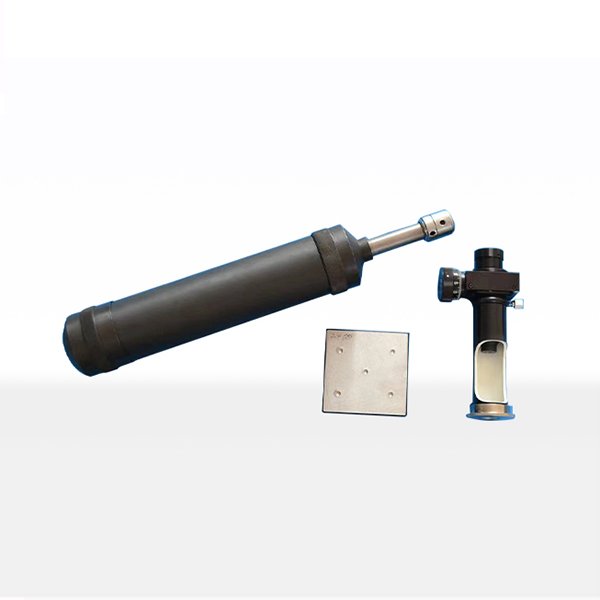
Overview
The HBX-0.5 Portable Brinell Hardness Tester is a portable instrument for measuring Brinell hardness directly on the part, where a bench instrument cannot reach. It uses dynamic measurement for high efficiency, and its compact size and sturdy structure make it suitable for Brinell hardness testing of large parts at the workplace. It is designed for ferrous metals whose modulus of elasticity is approximately equal to 2×10⁵ MPa.
HBX-0.5 technical specifications
| Parameter | Specification |
|---|---|
| Measuring range | 100–400 HBS |
| Impact energy | 4.9 joules |
| Dimensions | 55 × 370 mm |
| Weight | about 3.3 kg |
| Accuracy standard | GB/T 231.2, ISO 6506-2, ASTM E10 |
| Standard configuration | Portable Brinell hardness block (1 pc); 20× reading microscope (1 pc) |
| Main features | Portable; dynamic measurement; high efficiency; small size and easy to carry; sturdy and durable structure; high-precision reading microscope measurement system |
How a portable Brinell test works
Brinell hardness is one of the oldest and most widely used hardness scales for metals. A hardened ball indenter is pressed into the surface under a controlled force and the diameter of the resulting indentation is measured; the softer the material, the larger the impression. Testing machines of this type are covered by ASTM E10 and ISO 6506. The HBX-0.5 applies its test force dynamically, so it can be carried to the workpiece instead of the workpiece being brought to a machine. The indentation is then read with the supplied 20× measuring microscope.
Because the part does not have to be cut or moved, portable testing is a practical way to verify large castings, forgings and machined components in the workshop or in the field. It complements the other Brinell testers in our range — the HB-3000B and the HBS-3000 digital display model — which are chosen when the work can be brought to the bench and higher repetition rates are wanted.
Choosing between portable and bench Brinell testers
The deciding question is whether the workpiece can be brought to the instrument. For large castings, heavy forgings and components that are already installed, the HBX-0.5 is the practical choice because the test head travels to the part. When the work can be placed on a bench and higher throughput is wanted, the HB-3000B and the HBS-3000 digital display Brinell tester in the same hardness tester range give a fixed, repeatable test position. Both approaches report Brinell hardness, and both refer to the same family of standards, so results from a portable unit and a bench unit can be used together in the same quality system.
Reading the result and keeping the instrument in check
After the indenter has been pressed in, the diameter of the impression is measured and converted to a Brinell value; the HBX-0.5 is supplied with a 20× reading microscope for exactly this step. Because hardness results are only meaningful when the instrument itself is sound, regular verification is important: calibration certificates for testing machines are normally issued for 12 months and should be traceable to national force standards. The portable Brinell hardness block supplied in the standard configuration is a convenient reference for day-to-day checks in the workshop.
Applications
The HBX-0.5 is used for incoming inspection of ferrous castings and forgings, hardness verification of large machined parts, checking heat-treated components on the shop floor, and field or site testing where the part cannot be moved. It is suited to any ferrous material whose elastic modulus is close to 2×10⁵ MPa, and to workplaces that need a genuinely portable Brinell instrument. Our company has supplied material testing machines and springs since 2014 from Jinan, China, and supports customers with the full metal testing catalogue.
Frequently asked questions
What is the measuring range of the HBX-0.5?
The HBX-0.5 measures a Brinell hardness range of 100–400 HBS.
Which standards does the HBX-0.5 conform to?
The accuracy of the HBX-0.5 conforms to GB/T 231.2, ISO 6506-2 and the American standard ASTM E10.
What material can it test?
It is designed for the determination of the Brinell hardness of ferrous metals whose modulus of elasticity is approximately equal to 2×10⁵ MPa, and it is especially suitable for Brinell hardness testing of large parts at the workplace.
What is included in the standard configuration?
The standard configuration includes a portable Brinell hardness block (1 pc) and a 20× reading microscope (1 pc) for measuring the indentation.
Why choose a portable tester instead of a bench Brinell tester?
A portable Brinell tester such as the HBX-0.5 is chosen when the part is too large or too heavy to bring to a bench instrument, or when the test must be made at the workplace. For smaller parts and laboratory use, bench models such as the HB-3000B and HBS-3000 digital display Brinell tester are available in our hardness tester range.
Related pages
- Hardness Testers
- HB-3000B Brinell Hardness Tester
- HBS-3000 Digital Display Brinell Hardness Tester
- Contact Us
Request a quotation
Send us your drawing, sample or specification — our engineering team will confirm feasibility and reply with a quotation. Email annie@chenjitester.com or call / WhatsApp +86 158 5311 1612.