HB-3000B Brinell Hardness Tester (3000 kgf Bench Brinell Machine)
Hardness Testers
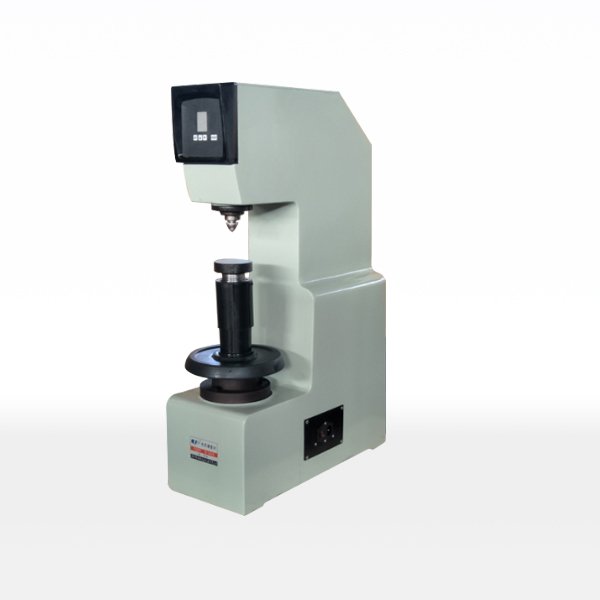
Overview
The HB-3000B is a bench Brinell hardness tester with the full 3000 kgf load range. Brinell testing presses a hardened ball into the surface and measures the diameter of the resulting indentation with a microscope, and because the ball and load are large the indentation averages a wide area of the material. That is exactly what makes Brinell the method of choice for castings, forgings and coarse-grained materials whose structure is not uniform over a small area.
The machine is lever loaded and manually operated, which keeps the mechanism simple and durable while holding a stable test accuracy in daily use. An electronic reversing switch and a high-precision reading microscope measurement system make the routine measurement of production parts fast and reliable.
Technical Specifications
| Parameter | Value |
|---|---|
| Measuring range | 8-650 HBW |
| Maximum sample height | 230 mm |
| Test force | 1838.8, 2451.8, 4903.5, 7355.3, 9807, 29421 N (187.5, 250, 500, 750, 1000, 3000 kgf) |
| Distance from the indenter centre to the machine wall | 120 mm |
| Minimum detection unit | 1 µm |
| Power supply | AC 220 V, 50/60 Hz |
| Overall dimensions | 660 × 500 × 1000 mm |
| Weight | about 210 kg |
Load range and the Brinell scales
The HB-3000B offers six test forces from 187.5 kgf up to 3000 kgf, so it can cover the standard Brinell loads used for different materials and ball diameters. The measuring range of 8-650 HBW spans soft aluminium and copper alloys through to hardened steels. ASTM E10 covers Brinell hardness testing of metallic materials, and the machine is built to GB/T 231.2, ISO 6506-2 and ASTM E10 accuracy. Because a Brinell result is based on the indentation diameter, the reading microscope is the heart of the measurement, and the HB-3000B uses a high-precision reading microscope system with a minimum detection unit of 1 µm.
Lever loading and everyday reliability
Lever loading gives a simple, robust mechanism that keeps its accuracy over long use, and the electronic reversing switch speeds up the loading and unloading cycle without adding complexity. The machine is widely applicable to quality monitoring in production sites and has strong adaptability to the working environment, so it is equally at home in a foundry inspection room and in a quieter laboratory. The 120 mm throat and 230 mm maximum sample height let it handle a wide range of cast and forged parts.
Applications
The HB-3000B is used to determine the Brinell hardness of ferrous metals, non-ferrous metals and bearing alloy materials, with a wide range of applications. It is suitable for the precision measurement of parallel planes and gives stable, reliable measurements on curved surfaces when the correct table is used. Typical users are foundries and forges, bearing and alloy makers, steel traders and the inspection laboratories that qualify castings, forgings and heat-treated parts. The standard configuration includes a large flat table, a small flat table and a V-type table, tungsten carbide ball indenters in Ø2.5, Ø5 and Ø10 mm, two standard Brinell hardness blocks and a 20x reading microscope.
Frequently Asked Questions
What is the HB-3000B used for?
It measures Brinell hardness – the hardness of ferrous metals, non-ferrous metals and bearing alloys – by pressing a ball into the surface at high load and measuring the indentation with a microscope. It suits castings, forgings and coarse-grained materials.
What is the measuring range and load of the HB-3000B?
The measuring range is 8-650 HBW and the test forces are 1838.8, 2451.8, 4903.5, 7355.3, 9807 and 29421 N, equal to 187.5, 250, 500, 750, 1000 and 3000 kgf.
Which standards does the HB-3000B follow?
It is built to GB/T 231.2, ISO 6506-2 and ASTM E10 accuracy. ASTM E10 covers Brinell hardness testing of metallic materials, so results are comparable with other compliant machines.
How is the Brinell indentation measured?
The indentation diameter is read with a high-precision reading microscope system that has a minimum detection unit of 1 µm, which is the basis of every Brinell hardness value the machine produces.
What is supplied with the HB-3000B as standard?
The standard configuration includes a large flat workbench, a small flat workbench and a V-shaped workbench, tungsten carbide ball indenters in Ø2.5, Ø5 and Ø10 mm, two standard Brinell hardness blocks and one 20x reading microscope.
Related Products & Pages
- Hardness Testers
- HBS-3000 Digital Display Brinell Hardness Tester
- HBX-0.5 Portable Brinell Hardness Tester
- Metallographic Hardness Testing
About CHENJI & Support
CHENJI is the brand of Jinan Chenji International Trade Co., Ltd. (Shandong, China), a manufacturer and exporter of material testing machines since 2014, with in-house quality control plus third-party inspection by SGS or Bureau Veritas. The company holds ISO 9001 certification (626024QH073R1) and is a Bureau Veritas audited supplier (MIC-ASR2451820). Testing machines are normally supplied with a calibration certificate valid for 12 months and traceable to national force standards, and our engineers help you select the machine, fixtures and accessories for your specimen and method.
Every quotation is prepared against the standard you test to, so the delivered machine matches the test method rather than only the headline capacity. Spare parts, consumables and calibration support are available after delivery, and machines can be produced to OEM or ODM requirements when a customer drawing or specification is provided.
Selecting and Verifying a Testing Machine
Choosing a machine is a matter of matching capacity to the specimen and the method, not of buying the largest frame. A 1000 kN machine is not suitable for a sample that needs 1 N of force; capacity selection follows the specimen and the standard, and the force measuring system should be verified per ISO 7500-1 or ASTM E4 on a regular schedule. Load cells are commonly supplied as class 0.5 or class 1, which means the indicated force stays within ±0.5% or ±1% of the true force.
Test results are only comparable when they are quoted together with the standard, the specimen geometry, the test speed and the force measurement class. We are glad to review your test method and specimen so that the machine, fixtures and accessories are correctly specified before you order.
Request a Quotation
Send CHENJI your material, part size and required Brinell load, and we will confirm the HB-3000B configuration and price.
Email annie@chenjitester.com or call / WhatsApp +86 158 5311 1612.