CXJU-22M Izod Impact Testing Machine with Touch Screen Control
Plastic Material Testing
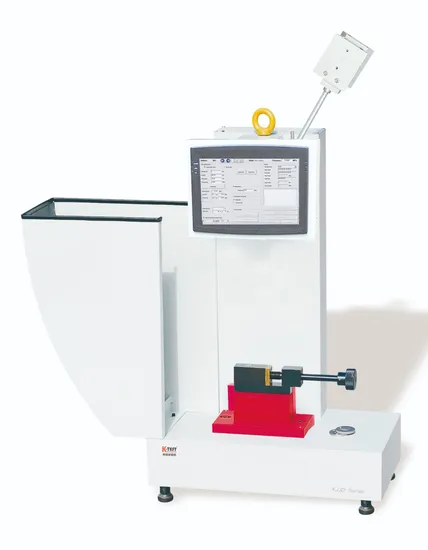
Overview
The CXJU-22M is an Izod impact testing machine with touch screen control, used to determine the impact toughness of non-metal materials such as rigid plastics, reinforced nylon, glass-reinforced plastics, ceramics, cast stone and electrical insulating materials. It is the kind of instrument used in the chemical industry, research institutes, universities and quality-inspection departments, and the whole test is controlled from a touch screen, which makes it easy to operate and reduces the chance of a setting mistake.
The machine is a digital type that adopts radial grating goniometry technology, which is why it combines high precision, good stability and a large measuring range. The touch screen is used both to set the parameters and to display the result; impact energy, impact strength, the advance angle, the rising angle, the average value of the sample set and the energy-loss self-correction are all handled by the instrument. A USB output lets the data be exported directly to a USB drive, and with the USB drive and the PC software the data can be imported to a computer for editing and printing the test report.
Technical Specifications
| Parameter | Value |
|---|---|
| Model | CXJU-22M |
| Controlled manner | Touch screen |
| Impact energy | Charpy test: 1 J, 2.75 J, 5.5 J, 11 J, 22 J (choose one) |
| Speed of impact | Charpy test: 3.5 m/s |
| Pre-elevation angle of pendulum | 150 degrees |
| Measurement system | Radial grating goniometry technology (digital) |
| Data output | USB, direct export to a USB drive; PC software for editing and printing reports |
| Functions | Impact energy, impact strength, advance angle, rising angle, sample average value, energy-loss self-correction |
| Applicable materials | Rigid plastics, reinforced nylon, glass-reinforced plastics, ceramics, cast stone, electrical insulating materials |
| Standards | ISO 180, GB/T 1843, GB/T 2611, JB/T 8761 |
Touch screen control and radial grating measurement
The machine is a digital type whose measurement uses radial grating goniometry, a technique in which the pendulum angle is read from a radial grating rather than a mechanical scale. It is this measurement principle that gives the machine high precision, good stability and a large measuring range, and the touch screen replaces the usual set of keys and dials: the operator enters the parameters on screen and reads the result there. The pre-elevation angle of the pendulum is 150 degrees and the impact speed for the Charpy test is 3.5 m/s.
Impact energy, averaging and self-correction
The instrument automatically computes impact energy, impact strength, the advance angle and the rising angle, calculates the average value of the samples in a set, and applies energy-loss self-correction. Averaging and self-correction matter in impact testing because the energy absorbed by a single specimen is small and the losses in the machine have to be removed before the material value is meaningful. The CXJU-22M is offered with a Charpy impact energy of 1 J, 2.75 J, 5.5 J, 11 J or 22 J, chosen at the time of order to suit the toughness of the material being tested.
Data handling and applications
A USB output allows the data to be exported directly to a USB drive, and with the USB drive and the PC software the results can be imported into a computer, edited and printed as a test report. The machine is mainly used for the impact toughness of non-metal materials – rigid plastics, reinforced nylon, glass-reinforced plastics, ceramics, cast stone and electrical insulating materials – and it accords with the demands of ISO 180, GB/T 1843, GB/T 2611 and JB/T 8761, which are the common Izod and plastics impact-testing standards.
Frequently Asked Questions
What materials is the CXJU-22M used for?
It determines the impact toughness of non-metal materials including rigid plastics, reinforced nylon, glass-reinforced plastics, ceramics, cast stone and electrical insulating materials. Typical users are the chemical industry, research institutes, universities and quality-inspection departments.
Which standards does the machine comply with?
It accords with the demands of ISO 180, GB/T 1843, GB/T 2611 and JB/T 8761.
What impact energies are available?
The Charpy impact energy is 1 J, 2.75 J, 5.5 J, 11 J or 22 J, chosen at order to suit the material. The impact speed is 3.5 m/s and the pendulum pre-elevation angle is 150 degrees.
What measurement principle does the machine use?
It is a digital type using radial grating goniometry technology, which gives high precision, good stability and a large measuring range, and the parameters and results are handled on a touch screen.
How is the test data exported?
The machine has a USB output and data can be exported directly to a USB drive. With the USB drive and the PC software supplied by the company, the data can be imported into a computer for editing and printing the experimental report.
Related Products & Pages
- Plastic Material Testing
- Impact & Pressure Testing
- 1J / 2.75J / 5.5J / 11J / 22J Digital Izod & Charpy Impact Tester
- Digital Display Impact Testing Machine
About CHENJI & Support
CHENJI is the brand of Jinan Chenji International Trade Co., Ltd. (Shandong, China), a manufacturer and exporter of material testing machines since 2014, with in-house quality control plus third-party inspection by SGS or Bureau Veritas. The company holds ISO 9001 certification (626024QH073R1) and is a Bureau Veritas audited supplier (MIC-ASR2451820). Testing machines are normally supplied with a calibration certificate valid for 12 months and traceable to national force standards, and our engineers help you select the machine, fixtures and accessories for your specimen and method.
Every quotation is prepared against the standard you test to, so the delivered machine matches the test method rather than only the headline capacity. Spare parts, consumables and calibration support are available after delivery, and machines can be produced to OEM or ODM requirements when a customer drawing or specification is provided.
Selecting and Verifying a Testing Machine
Choosing a machine is a matter of matching capacity to the specimen and the method, not of buying the largest frame. A 1000 kN machine is not suitable for a sample that needs 1 N of force; capacity selection follows the specimen and the standard, and the force measuring system should be verified per ISO 7500-1 or ASTM E4 on a regular schedule. Load cells are commonly supplied as class 0.5 or class 1, which means the indicated force stays within ±0.5% or ±1% of the true force.
Test results are only comparable when they are quoted together with the standard, the specimen geometry, the test speed and the force measurement class. We are glad to review your test method and specimen so that the machine, fixtures and accessories are correctly specified before you order.
Request a Quotation
Tell CHENJI the material and the impact energy you need, and we will confirm the CXJU-22M Izod impact testing machine, pendulum and specimens for a quotation.
Email annie@chenjitester.com or call / WhatsApp +86 158 5311 1612.