CXNR-400D MFR / MVR Melt Flow Rate Meter with Touch Screen Display
Plastic Material Testing
Overview
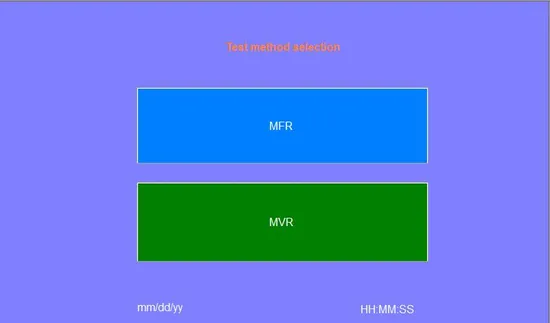
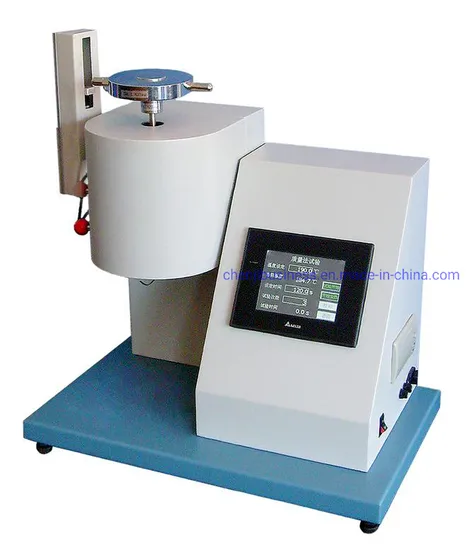
The CXNR-400D is a melt flow rate meter with a colour touch screen display and a built-in printer, designed and manufactured to GB/T 3682, ASTM D1238, JB/T 5456 and ISO 1133 for the determination of the melt mass flow rate (MFR) and the melt volume flow rate (MVR) of thermoplastics. It combines both test methods in one instrument, so a laboratory can report gravimetric and volumetric flow rates from the same machine.
The melt mass flow rate is measured by manual or automatic sampling and weighing on a balance, while the melt volume flow rate is measured by a displacement sensor and an automatic timing system: the time the piston needs to travel a specified distance is measured first and the volume flow rate is then calculated from it. The final results of both determination methods are printed out by the micro printer, and the extrusion is cut off automatically for repeatable sampling.
Technical Specifications
| Parameter | Value |
|---|---|
| Model | CXNR-400D |
| Test methods | MFR and MVR (melt mass flow rate and melt volume flow rate) |
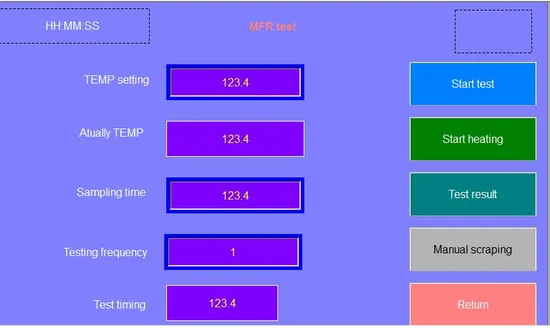
| Display | Colour touch screen; PLC microcomputer control |
| Printer | Built-in micro printer |
| Die inner diameter | Phi 2.095 +/- 0.005 mm |
| Die length | 8.000 +/- 0.025 mm |
| Barrel inner diameter | Phi 9.550 +/- 0.007 mm |
| Barrel length | 152 +/- 0.1 mm |
| Piston rod diameter | 9.474 +/- 0.007 mm |
| Piston rod head length | 6.350 +/- 0.10 mm |
| Test load | Eight levels, 0.325 kg to 21.600 kg (3.187 N to 211.82 N) |
| Temperature control range | 50-450 degC; accuracy +/-0.2 degC, resolution 0.1 degC |
| Time range | 0-999 s (measurement 0-999.99 s, accuracy +/-0.1 s) |
| Displacement sensor range | 0-40 mm, accuracy +/-0.05 mm |
| Overall dimensions | 550 x 370 x 600 mm |
| Weight | 25 kg (host 21.6 kg) |
| Indicative price / MOQ | US$1,500.00-2,500.00 per set; MOQ 1 set |
| Certification | TUV |
| Standards | ISO 1133, GB/T 3682, ASTM D1238, JB/T 5456 |
MFR and MVR in one instrument
The instrument supports both test methods demanded by the plastics industry. For MFR the extrudate is sampled by hand or automatically and weighed on a balance; for MVR a displacement sensor and an automatic timing system record the time the piston takes to move a specified distance, from which the volume flow rate is calculated. Both results are printed by the micro printer, and the automatic cut-off of the extrusion removes the operator-to-operator variation that affects manual sampling.
The eight standard test loads run from 0.325 kg (3.187 N) up to 21.600 kg (211.82 N) and are built from the piston rod, the weight tray and a set of weights so that the load required by the standard is assembled exactly. The relative error of the weight of the piston rod and the combined weight is not more than +/-0.5%.
Construction and operating range
The instrument uses a colour touch screen display with PLC microcomputer control and a modular circuit, giving accurate measurement data with simple, intuitive operation and stable, reliable performance. The barrel is heated to a controlled 50-450 degC with +/-0.2 degC accuracy and 0.1 degC resolution, which covers both high-melting engineering plastics such as polycarbonate, fluoroplastics and nylon and lower-melting materials such as polyethylene and ABS.
The compact instrument measures 550 x 370 x 600 mm and weighs about 25 kg, so it fits on a normal laboratory bench, and it is used in plastics production, plastic products and petrochemical plants as well as in colleges, scientific research units and commodity inspection departments.
Standards and application
The CXNR-400D is manufactured to GB/T 3682 and JB/T 5456 and complies with ISO 1133 and ASTM D1238, the international and American methods for the determination of the melt mass-flow rate and melt volume-flow rate of thermoplastics. Because it reports both MFR and MVR, it serves incoming-material inspection, production quality control and research on new polymer grades, and the printed results give a permanent record for the batch file.
The instrument is supplied with an indicative price of US$1,500.00-2,500.00 per set and a minimum order quantity of one set, and carries TUV certification.
Frequently Asked Questions
Which test methods does the instrument support?
It supports both MFR (melt mass flow rate) and MVR (melt volume flow rate), so gravimetric and volumetric results can be reported from the same machine.
Which standards does it comply with?
ISO 1133, GB/T 3682, ASTM D1238 and JB/T 5456 for the determination of the melt mass-flow rate and melt volume-flow rate of thermoplastics.
What temperature range does it reach?
The barrel is controlled from 50 to 450 degC with +/-0.2 degC accuracy and 0.1 degC resolution, covering both engineering plastics and lower-melting materials such as PE and ABS.
How many test loads are available?
Eight standard load levels from 0.325 kg (3.187 N) up to 21.600 kg (211.82 N), assembled from the piston rod, weight tray and weights with a relative error of not more than +/-0.5%.
Is a printer included?
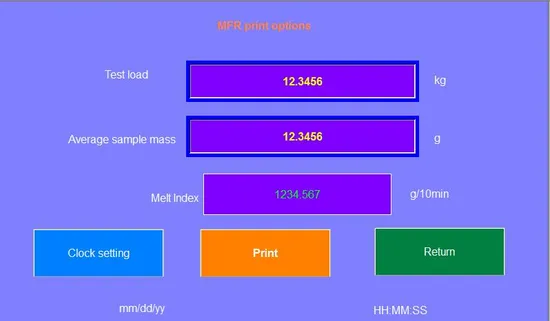
Yes. The instrument has a built-in micro printer that prints the results of both determination methods, and the extrusion is cut off automatically.
Related Products & Pages
- Plastic Material Testing
- CDSC-500A Automatic Differential Scanning Calorimeter
- Pipe & Plastic Testing
- Rubber Testing
About CHENJI & Support
CHENJI is the brand of Jinan Chenji International Trade Co., Ltd. (Shandong, China), a manufacturer and exporter of material testing machines since 2014, with in-house quality control plus third-party inspection by SGS or Bureau Veritas. The company holds ISO 9001 certification (626024QH073R1) and is a Bureau Veritas audited supplier (MIC-ASR2451820). Testing machines are normally supplied with a calibration certificate valid for 12 months and traceable to national force standards, and our engineers help you select the machine, fixtures and accessories for your specimen and method.
Every quotation is prepared against the standard you test to, so the delivered machine matches the test method rather than only the headline capacity. Spare parts, consumables and calibration support are available after delivery, and machines can be produced to OEM or ODM requirements when a customer drawing or specification is provided.
Selecting and Verifying a Testing Machine
Choosing a machine is a matter of matching capacity to the specimen and the method, not of buying the largest frame. Capacity selection follows the specimen and the standard, and the force measuring system should be verified per ISO 7500-1 or ASTM E4 on a regular schedule. Load cells are commonly supplied as class 0.5 or class 1, which means the indicated force stays within ±0.5% or ±1% of the true force.
Test results are only comparable when they are quoted together with the standard, the specimen geometry, the test speed and the force measurement class. We are glad to review your test method and specimen so that the machine, fixtures and accessories are correctly specified before you order.
Request a Quotation
Tell CHENJI the polymer you test and the flow-rate standard you work to, and we will confirm the CXNR-400D configuration, the load set and the delivery for a quotation.
Email annie@chenjitester.com or call / WhatsApp +86 158 5311 1612.
More Photos