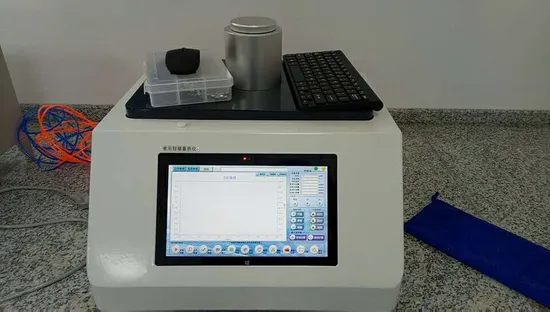
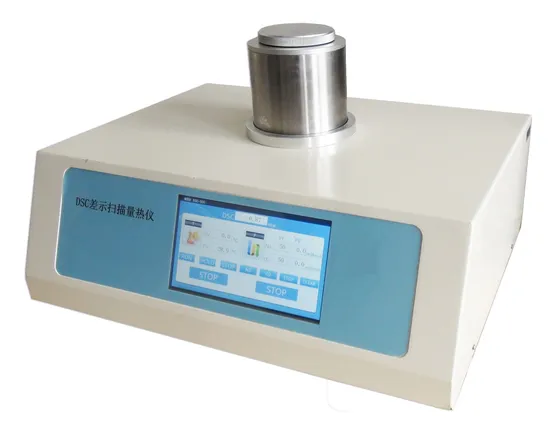
CDSC-500A Auto Software DSC Differential Scanning Calorimeter
Plastic Material Testing
Overview
The CDSC-500A is an automatic differential scanning calorimeter (DSC) with its own operating software. It is used for the characterisation of a great variety of materials: in polymers, and here not only in plastics and rubber processing but also in the pharmaceutical, food packaging and technical textile fields. DSC is a classical thermal-analysis method based on the heating effect at a programmable temperature, and it is widely applied in research and development, process optimisation, quality control and failure analysis across many material and chemical fields.
Using the DSC method the machine can accurately test the oxidation induction time of a material. It is widely used for plastic, rubber, paint, food, medicine, biological organisms, inorganic materials, metal materials and composite materials, and it is built to the standards GB 1739.1-1998 and ISO/CD 11357/6.
Technical Specifications
| Parameter | Value |
|---|---|
| Functions | Material characterisation, including oxidation induction time; used in polymers, plastics, rubber, pharmaceutical, food packaging and technical textiles |
| Standards | GB 1739.1-1998 and ISO/CD 11357/6 |
| Temperature range | Room temperature to 800 °C |
| Temperature resolution | 0.1 °C |
| Heating rate | 0.1~80 °C/min |
| DSC range | 0~+500 mW |
| DSC resolution | 0.01 mW |
| DSC sensitivity | 0.1 mW |
| Display | Touch screen showing set temperature, sample temperature, oxygen flow, nitrogen flow, differential thermal signal and switch states |
| Communication | USB interface with restore-connection function |
| Atmosphere control | Digital gas mass flow meter with automatic two-way switching; fast switching and short stabilisation time |
| Furnace | Compact structure with freely adjustable cooling rate; machinery-fixed installation to avoid contamination of the furnace interior |
| Temperature sensing | Double temperature probe for repeatable sample-temperature height, with a probe at the bottom of the sample to measure the real sample temperature |
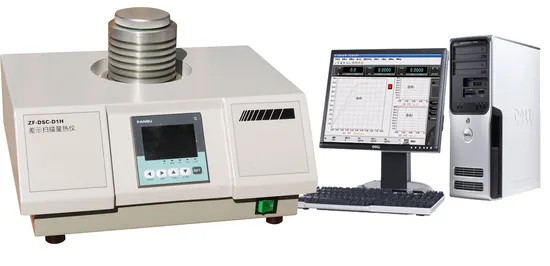
| Software | Adaptive screen resolution; supports notebook and desktop and the Win2000, XP, VISTA and Windows 7 operating systems; user-programmable measurement procedures |
| Power supply | AC 220 V / 50 Hz (or custom) |
| Calibration | Standard samples are supplied for convenient constant-temperature correction of the coefficient |
What the CDSC-500A measures
A differential scanning calorimeter measures the heat flow into and out of a sample as its temperature is programmed, which reveals transitions, reactions and thermal events in the material. The CDSC-500A is used for the characterisation of many materials, and it can accurately test the oxidation induction time of a material, a measurement that is widely used to judge the thermal-oxidative stability of polymers. The same instrument is applied in polymer and rubber processing, in the pharmaceutical and food-packaging industries and in technical textiles, and for plastic, rubber, paint, food, medicine, biological, inorganic, metal and composite materials.
The temperature range runs from room temperature to 800 °C with a temperature resolution of 0.1 °C and a heating rate from 0.1 to 80 °C/min, so the machine covers both slow, high-precision scans and faster routine measurements. The DSC signal has a range of 0 to +500 mW with a resolution of 0.01 mW and a sensitivity of 0.1 mW.
Thermal design and atmosphere control
The instrument uses a double temperature probe: one probe is installed on the furnace wall for the PID control of the furnace-body temperature, and a second probe is fitted at the bottom of the sample to measure the real temperature of the sample. This two-probe arrangement is used because the wall temperature lags the sample through thermal inertia, so control and measurement from a single probe give a larger error in the differential thermal and temperature signals. With the dedicated temperature-control technology, the furnace-wall temperature is driven so that the sample reaches the set temperature.
The furnace structure is compact with a freely adjustable cooling rate, and the installation uses a machinery-fixed method that completely avoids contamination of the furnace interior by colloid, which would otherwise disturb the differential thermal signal. The atmosphere is handled by a digital gas mass flow meter with automatic two-way switching between gases, giving fast switching and a short stabilisation time.
Display, communication and software
A touch screen displays a wide range of information, including the set temperature, the sample temperature, the oxygen flow, the nitrogen flow, the differential thermal signal and the various switch states, so the operator watches the run without needing a separate console. Communication is over a USB interface with a generality that supports a restore-connection function, so a brief interruption does not lose the run. Standard samples are supplied for convenient constant-temperature correction of the coefficient.
The operating software adapts to the resolution of the computer screen and adjusts the curve display mode automatically; it supports notebook and desktop computers and the Win2000, XP, VISTA and Windows 7 operating systems. The software also supports user-programmed procedures for a fully automatic measuring step: it provides dozens of commands that the user can combine into a saved measurement sequence, so a complex operation is simplified into a one-key operation.
Frequently Asked Questions
What is the CDSC-500A used for?
It is a differential scanning calorimeter used for the characterisation of many materials, including the accurate testing of oxidation induction time; it is applied in polymers, plastics, rubber, pharmaceutical, food packaging and technical textile work.
What are the temperature range and resolution?
The temperature range is room temperature to 800 °C with a resolution of 0.1 °C, and the heating rate is 0.1~80 °C/min.
What is the DSC range and sensitivity?
The DSC range is 0~+500 mW with a resolution of 0.01 mW and a sensitivity of 0.1 mW.
Which standards does it follow?
The instrument is built to the standards GB 1739.1-1998 and ISO/CD 11357/6.
How does the atmosphere and data handling work?
A digital gas mass flow meter switches automatically between two gas flows, a USB interface handles communication with a restore-connection function, and the software supports user-programmed procedures and automatic screen-resolution adaptation.
Related Products & Pages
About CHENJI & Support
CHENJI is the brand of Jinan Chenji International Trade Co., Ltd. (Shandong, China), a manufacturer and exporter of material testing machines since 2014, with in-house quality control plus third-party inspection by SGS or Bureau Veritas. The company holds ISO 9001 certification (626024QH073R1) and is a Bureau Veritas audited supplier (MIC-ASR2451820). Testing machines are normally supplied with a calibration certificate valid for 12 months and traceable to national force standards, and our engineers help you select the machine, fixtures and accessories for your specimen and method.
Every quotation is prepared against the standard you test to, so the delivered machine matches the test method rather than only the headline capacity. Spare parts, consumables and calibration support are available after delivery, and machines can be produced to OEM or ODM requirements when a customer drawing or specification is provided.
Selecting and Verifying a Testing Machine
Choosing a machine is a matter of matching capacity to the specimen and the method, not of buying the largest frame. A 1000 kN machine is not suitable for a sample that needs 1 N of force; capacity selection follows the specimen and the standard, and the force measuring system should be verified per ISO 7500-1 or ASTM E4 on a regular schedule. Load cells are commonly supplied as class 0.5 or class 1, which means the indicated force stays within ±0.5% or ±1% of the true force.
Test results are only comparable when they are quoted together with the standard, the specimen geometry, the test speed and the force measurement class. We are glad to review your test method and specimen so that the machine, fixtures and accessories are correctly specified before you order.
Request a Quotation
Tell CHENJI the material and the thermal event you need to measure, and we will confirm the CDSC-500A differential scanning calorimeter, the gas flows and the standard samples for a quotation.
Email annie@chenjitester.com or call / WhatsApp +86 158 5311 1612.
More Photos