JB-WCDZ Microcomputer Control Ultra-Low Temperature Automatic Impact Testing Machine
Impact & Pressure Testing
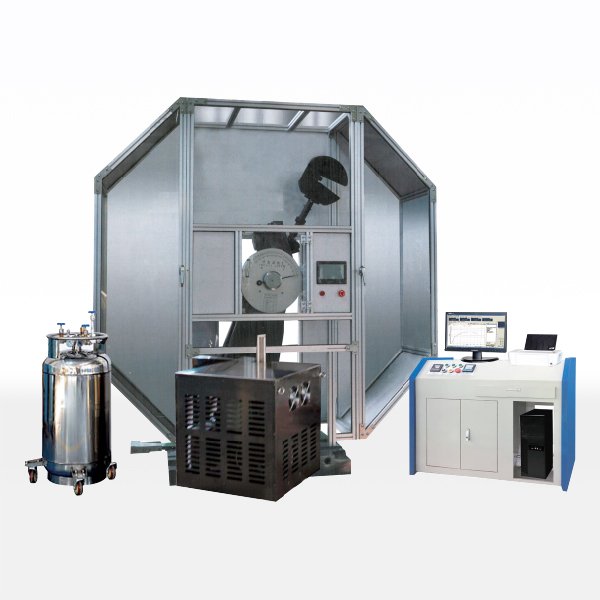
Overview
The JB-WCDZ is a microcomputer-controlled ultra-low temperature automatic impact testing machine used to test the impact resistance of metal materials at low temperature. Its layout is arranged to reduce deformation of the main shaft and to cut the energy loss caused by bearing friction, which matters because the measured energy is small at low temperature and the machine’s own losses have to be kept under control. It is a necessary instrument for metallurgy and machinery manufacturing plants and is also used by research units working on new materials.
The machine uses a geared motor to lift the hammer and runs smoothly. The pendulum is designed with three-dimensional software so that the striking centre is accurate and the torque of the pendulum is precise, and the machine uses PLC control. The settings are all electrical and mechanical, and a special feeding device feeds the specimens automatically, with automatic end-face positioning. A safety protection pin and a safety protection net protect the operator, and the sample leaves the furnace and is struck in not more than 2 seconds, which meets the requirement of the metal low-temperature Charpy impact test method.
Technical Specifications
| Parameter | Value |
|---|---|
| Models | JB-W300/450/500/600/750CDZ (liquid nitrogen); JB-W300/450/500/600/750CYZ (compressor) |
| Refrigeration method | Liquid nitrogen (CDZ); compressor (CYZ) |
| Temperature control range (room temperature ≤ 25 °C) | Room temperature to -196 °C (CDZ); room temperature to -60 / -80 °C (CYZ) |
| Constant temperature accuracy | ±1 °C (CDZ); ±0.5 °C (CYZ) |
| Cooling rate | Room temperature to -196 °C in not more than 60 minutes (CDZ); room temperature to -80 °C in not more than 90 minutes (CYZ) |
| Sample specifications | 10 × 10 × 55 mm, 10 × 7.5 × 55 mm, 10 × 5 × 55 mm, 10 × 2.5 × 55 mm |
| Cooling chamber sample capacity | 20 pieces |
| Sample delivery positioning method | Pneumatic |
| Protective device | Aluminium alloy fully enclosed protective net |
| Host motor | 0.37 kW |
| Hammer lift | Geared motor |
| Control | PLC control; settings all electrical and mechanical |
| Time from out-of-furnace to impact | Not more than 2 seconds |
| Standards | GB/T 3808-2002 (Inspection of Pendulum Impact Testing Machines); GB/T 229-2007 (Metallic materials — Charpy pendulum impact test method) |
Ultra-low temperature impact testing
Testing at very low temperature shows how a metal behaves when it is cold and more prone to brittle fracture, and the CDZ version of the machine uses liquid nitrogen to reach room temperature down to -196 °C, with a constant-temperature accuracy of about ±1 °C and a cooling time from room temperature to -196 °C of not more than 60 minutes. The CYZ version uses a compressor and covers room temperature down to -60 °C or -80 °C with an accuracy of about ±0.5 °C. The cooling chamber holds 20 specimens, so a batch can be soaked together and then fed and struck one after another without the operator handling cold samples.
Frame, pendulum and energy loss
Because the machine is arranged to reduce deformation of the main shaft and to cut bearing friction, the energy lost inside the machine is small and the energy absorbed by the specimen can be measured reliably, which is important when the absorbed energy at low temperature is low. The pendulum is designed with three-dimensional software so that the striking centre is accurate and the torque is precise, and a geared motor lifts the hammer smoothly. Operation follows the inspection requirements of GB/T 3808-2002 and the machine carries out tests to GB/T 229-2007, the Charpy pendulum impact test method.
Safety, automation and sample handling
The machine uses PLC control and the settings are all electrical and mechanical, with a special feeding device for automatic feeding and automatic end-face positioning of the sample. Samples 10 × 10 × 55 mm, 10 × 7.5 × 55 mm, 10 × 5 × 55 mm and 10 × 2.5 × 55 mm can be tested; the first is the standard Charpy size, and the reduced-width specimens are used where the material of the part limits the sample that can be taken. The time from the sample leaving the furnace to the impact is not more than 2 seconds, and an aluminium alloy fully enclosed protective net keeps the operator safe. The host motor is 0.37 kW.
Frequently Asked Questions
What temperatures can the JB-WCDZ reach?
The liquid-nitrogen CDZ version reaches room temperature down to -196 °C, and the compressor CYZ version covers room temperature down to -60 / -80 °C.
How many samples does the cooling chamber hold?
The cooling chamber holds 20 pieces, and samples 10 × 10 × 55 mm, 10 × 7.5 × 55 mm, 10 × 5 × 55 mm and 10 × 2.5 × 55 mm can be tested.
How long may a sample be out of the furnace before impact?
Not more than 2 seconds, which meets the requirement of the metal low-temperature Charpy impact test method.
Which standards does the machine follow?
It complies with GB/T 3808-2002, Inspection of Pendulum Impact Testing Machines, and carries out impact tests to GB/T 229-2007, the metal Charpy pendulum impact test method.
What control and safety features are provided?
The machine uses PLC control with a geared motor to lift the hammer, a special feeding device with automatic end-face positioning and pneumatic sample delivery, and an aluminium alloy fully enclosed protective net for operator safety.
Related Products & Pages
- Impact & Pressure Testing
- JB-W300/500/YZ Low Temperature Impact Testing Machine
- Digital Display Impact Testing Machine
- CXJU-22M Izod Impact Testing Machine
About CHENJI & Support
CHENJI is the brand of Jinan Chenji International Trade Co., Ltd. (Shandong, China), a manufacturer and exporter of material testing machines since 2014, with in-house quality control plus third-party inspection by SGS or Bureau Veritas. The company holds ISO 9001 certification (626024QH073R1) and is a Bureau Veritas audited supplier (MIC-ASR2451820). Testing machines are normally supplied with a calibration certificate valid for 12 months and traceable to national force standards, and our engineers help you select the machine, fixtures and accessories for your specimen and method.
Every quotation is prepared against the standard you test to, so the delivered machine matches the test method rather than only the headline capacity. Spare parts, consumables and calibration support are available after delivery, and machines can be produced to OEM or ODM requirements when a customer drawing or specification is provided.
Selecting and Verifying a Testing Machine
Choosing a machine is a matter of matching capacity to the specimen and the method, not of buying the largest frame. A 1000 kN machine is not suitable for a sample that needs 1 N of force; capacity selection follows the specimen and the standard, and the force measuring system should be verified per ISO 7500-1 or ASTM E4 on a regular schedule. Load cells are commonly supplied as class 0.5 or class 1, which means the indicated force stays within ±0.5% or ±1% of the true force.
Test results are only comparable when they are quoted together with the standard, the specimen geometry, the test speed and the force measurement class. We are glad to review your test method and specimen so that the machine, fixtures and accessories are correctly specified before you order.
Request a Quotation
Tell CHENJI the test temperature, the specimen size and the standard, and we will confirm the JB-WCDZ impact testing machine, the liquid-nitrogen or compressor cooling system and the sample fixtures for a quotation.
Email annie@chenjitester.com or call / WhatsApp +86 158 5311 1612.