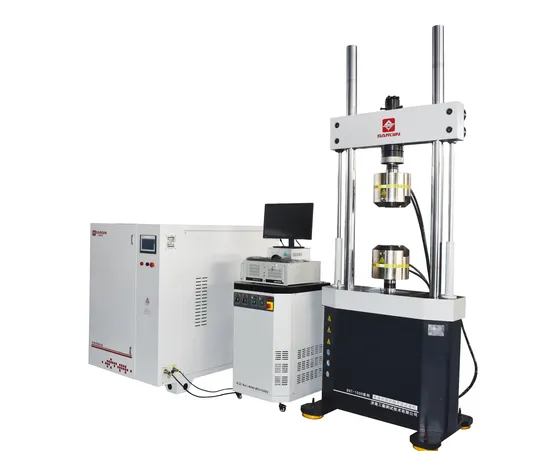
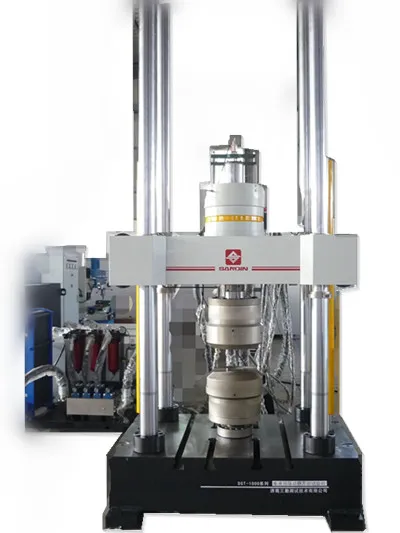
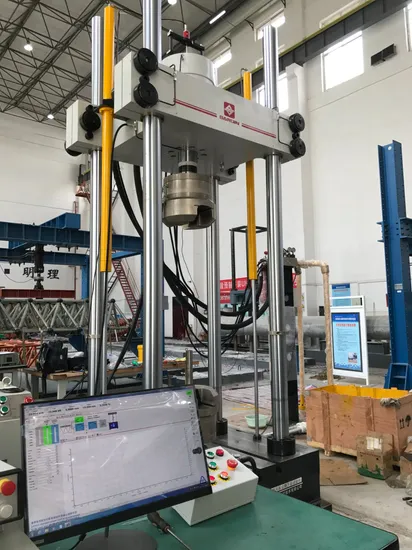
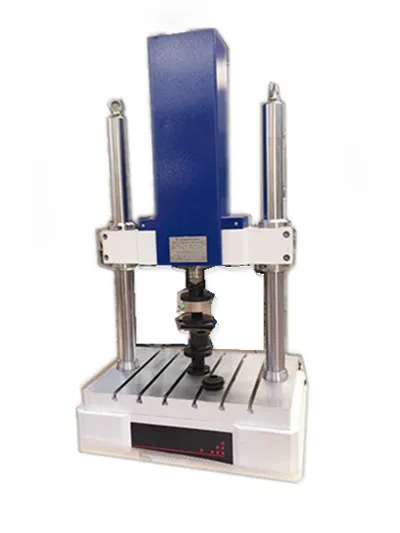
10 kN / 25 kN / 50 kN / 100 kN Electro-Hydraulic Servo Dynamic and Static Universal Test Machine (DST2000 Series)
Fatigue Testing Machines
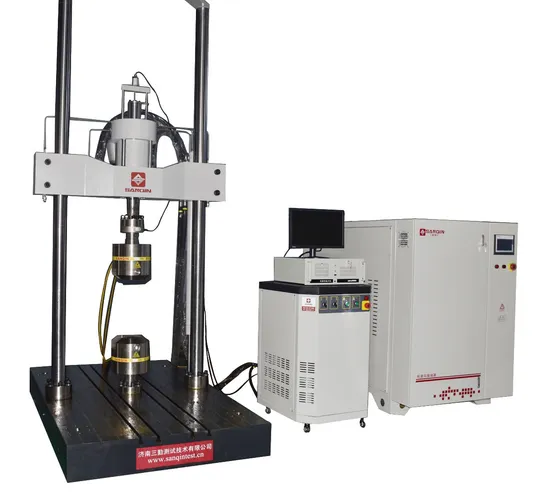
Overview
The DST2000 series is an electro-hydraulic servo dynamic and static universal test machine for the mechanical fatigue testing of metals and other materials, including low-carbon steel, titanium alloy and other metal materials, and carbon fibre, glass fibre and other non-metallic materials and composites. It also performs tensile-compression-bending fatigue tests on building materials, such as steel-bar tension, concrete compression and rock or soil block compression, so the same frame serves both materials testing and structural-material testing.
Because the machine combines dynamic and static capability in one servo-hydraulic frame, it can run a fatigue test and then a static test without moving the specimen. The actuator is a double-rod double-acting type with a standard amplitude of ± 75 mm and an option of ± 100 mm or ± 150 mm, and the actual stroke is greater than twice the amplitude. Test force accuracy is ± 1.0% or ± 0.5% over a testing range of ± 2% to 100% FS, and displacement accuracy is ± 0.5% FS.
Technical Specifications
| Parameter | Value |
|---|---|
| Series / models | DST2000 series: DST2104, DST1254, DST2504, DST2105, DST2205, DST2255 |
| Max loading | ± 10 / ± 25 / ± 50 / ± 100 / ± 200 / ± 250 kN |
| Test force accuracy | ± 1.0% or ± 0.5% (testing range ± 2% – 100% FS) |
| Actuator amplitude | Standard ± 75 mm (optional ± 100 mm, ± 150 mm); actual stroke greater than 2 times the amplitude |
| Actuator structure | Double rod double acting |
| Displacement accuracy | ± 0.5% FS |
| Frequency range | 0.001 – 35 Hz (or 0.1 – 100 Hz); 0.001 – 25 Hz (or 0.1 – 60 Hz) |
| Test waveform | Sine, triangle, square, ramp; user-defined waveforms such as pulse, half-sine and half-triangle |
| Optional fixtures | Mechanical tension, compression and bending fixtures; hydraulic chucks |
| Optional accessories | High and low temperature environmental box; high temperature furnace; confining pressure box |
| Column width | 500 / 550 / 620 mm |
| Test height | 700 (400) / 1000 (600) / 1200 (400) mm |
| Dimensions | 620 × 450 × 1250 mm; 980 × 620 × 2700 mm |
| Recommended oil source | 10 / 23 / 36 / 45 / 70 / 90 / 150 L/min, preset pressure 21 MPa |
| Customisation | Actuator amplitude and structure, test space and oil source (high-efficiency or silent) can be customised |
Dynamic and static testing in one frame
The machine is built around an electro-hydraulic servo actuator whose double-rod double-acting construction applies equal force in both directions, which is what a tension-compression fatigue test requires. A standard amplitude of ± 75 mm gives generous travel for component tests, and because the actual stroke is more than twice the amplitude, the actuator is not pushed to its limit at full travel. The same frame also applies static load, so a fatigue test and a static tensile or compression test can be run on one machine without changing the setup.
Waveforms, frequency and control
Test waveforms include sine, triangle, square and ramp, and user-defined waveforms such as pulse, half-sine and half-triangle can be added, which matters when a non-standard load history has to be reproduced. The frequency range extends from 0.001 Hz to 35 Hz (or 0.1 to 100 Hz depending on the model group), covering low-cycle and intermediate-cycle fatigue, and the load, displacement and deformation channels are accurate to ± 1.0% and ± 0.5% FS respectively.
Fixtures, accessories and customisation
Optional fixtures include mechanical tension, compression and bending fixtures, and hydraulic chucks for higher-throughput work. Optional accessories extend the machine into environmental testing: a high and low temperature environmental box, a high temperature furnace and a confining pressure box are available. The column width is 500, 550 or 620 mm and the test height 700 (400), 1000 (600) or 1200 (400) mm. The amplitude and structure of the actuator, the test space and the oil source – which is recommended at 10 to 150 L/min with a preset pressure of 21 MPa, and can be a high-efficiency or a silent unit – can all be customised to the application.
Frequently Asked Questions
What is an electro-hydraulic servo dynamic and static test machine used for?
It performs mechanical fatigue tests on metals and other materials – including low-carbon steel, titanium alloy, carbon fibre, glass fibre and composites – and tensile-compression-bending fatigue tests on building materials such as steel bar, concrete and rock or soil blocks. It also applies static load.
What capacities does the DST2000 series cover?
Six models cover maximum loading of ± 10, ± 25, ± 50, ± 100, ± 200 and ± 250 kN (DST2104, DST1254, DST2504, DST2105, DST2205, DST2255).
What is the actuator amplitude and structure?
The actuator is a double-rod double-acting type with a standard amplitude of ± 75 mm, optional ± 100 mm or ± 150 mm. The actual stroke is greater than twice the amplitude, and the amplitude and structure can be customised.
What waveforms and frequencies can the machine run?
Sine, triangle, square and ramp waveforms, plus customisable user-defined waveforms such as pulse, half-sine and half-triangle. The frequency range is 0.001-35 Hz (or 0.1-100 Hz) for some models and 0.001-25 Hz (or 0.1-60 Hz) for others.
Can the machine be used for high-temperature testing?
Yes. Optional accessories include a high and low temperature environmental box, a high temperature furnace and a confining pressure box. Mechanical tension, compression and bending fixtures and hydraulic chucks are also available.
Related Products & Pages
- Fatigue Testing Machines
- Metal Testing Machines
- HST-HFT Electro-Hydraulic Servo Fatigue Testing Machine
- EDT Series Electronic Fatigue Testing Machine
About CHENJI & Support
CHENJI is the brand of Jinan Chenji International Trade Co., Ltd. (Shandong, China), a manufacturer and exporter of material testing machines since 2014, with in-house quality control plus third-party inspection by SGS or Bureau Veritas. The company holds ISO 9001 certification (626024QH073R1) and is a Bureau Veritas audited supplier (MIC-ASR2451820). Testing machines are normally supplied with a calibration certificate valid for 12 months and traceable to national force standards, and our engineers help you select the machine, fixtures and accessories for your specimen and method.
Every quotation is prepared against the standard you test to, so the delivered machine matches the test method rather than only the headline capacity. Spare parts, consumables and calibration support are available after delivery, and machines can be produced to OEM or ODM requirements when a customer drawing or specification is provided.
Selecting and Verifying a Testing Machine
Choosing a machine is a matter of matching capacity to the specimen and the method, not of buying the largest frame. A 1000 kN machine is not suitable for a sample that needs 1 N of force; capacity selection follows the specimen and the standard, and the force measuring system should be verified per ISO 7500-1 or ASTM E4 on a regular schedule. Load cells are commonly supplied as class 0.5 or class 1, which means the indicated force stays within ±0.5% or ±1% of the true force.
Test results are only comparable when they are quoted together with the standard, the specimen geometry, the test speed and the force measurement class. We are glad to review your test method and specimen so that the machine, fixtures and accessories are correctly specified before you order.
Request a Quotation
Tell CHENJI the component, the load range and the waveform you need, and we will confirm the DST2000 electro-hydraulic servo dynamic and static test machine, fixtures and oil source for a quotation.
Email annie@chenjitester.com or call / WhatsApp +86 158 5311 1612.
More Photos