D915-2 Belt Grinding Machine for Spectroscopic Samples (Compact Dual-Belt Grinder)
Spectroscopy & Analysis
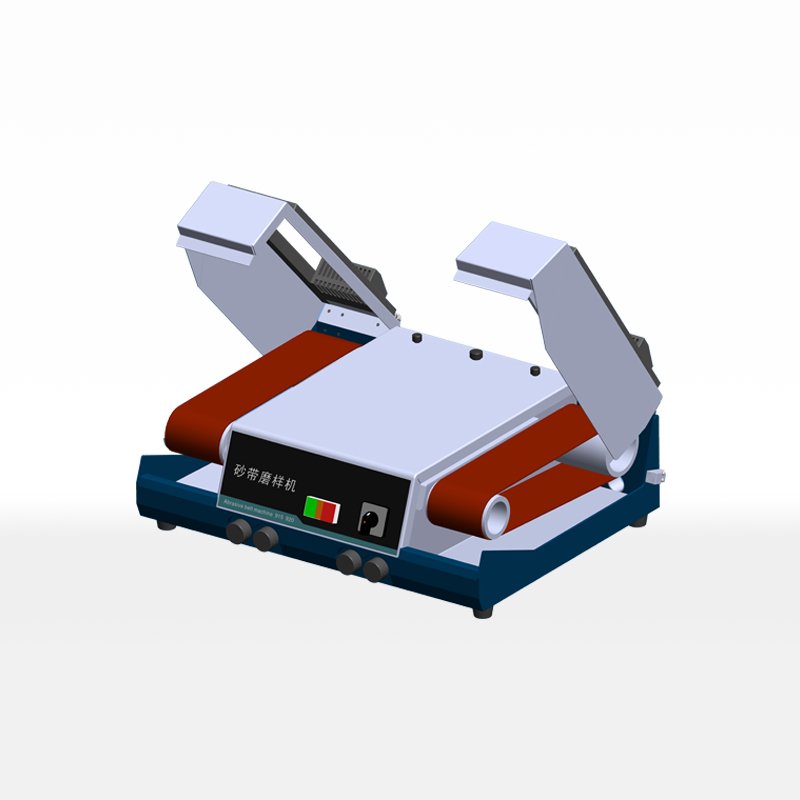
Overview
The D915-2 belt grinding machine is the compact member of the D915 / BG-32 series, built for fast pre-grinding and deburring of metal samples before spectrometric analysis. Like the rest of the series it uses a dual-belt design, so two different grit belts can be mounted at the same time for rough and fine grinding, saving time and consumable cost on every sample.
A spectrometric result is only as good as the surface prepared for it, and a sample that has been ground by hand is neither flat nor consistent from one piece to the next. The D915-2 gives a repeatable surface in a smaller, lighter frame, and it works either dry or wet – in wet mode circulating cooling water keeps the sample surface cool and prevents structural changes that would distort the analysis.
Technical Specifications
| Parameter | Value |
|---|---|
| Motor power | 1.1 kW |
| Power supply | AC 380 V |
| Belt speed | 7 m/sec |
| Belt size | 100 × 915 mm (D915-2) |
| Inlet pipe / outlet pipe | DN20 / DN32 |
| Dimensions (W × H × D) | 510 × 250 × 520 mm (D915-2) |
| Weight | 50 kg (D915-2) |
| Belt change | Quick, without tools – loosen the front knob, release tension and slide the belt off |
| Optional | Wet grinding kit with circulating water tank |
A compact dual-belt grinder
The D915-2 keeps the dual-belt principle but reduces the frame to 510 × 250 × 520 mm and about 50 kg, so it occupies less bench space and is easier to move than the larger D915-1. Two belts of different grit are mounted at the same time, letting the operator move from rough pre-grinding to a fine finish without stopping to change belts. The belt itself is swapped quickly without tools: loosen the front knob, release the tension and slide the belt off.
Wet and dry sample preparation
Both dry and wet grinding modes are available. In wet mode a circulating cooling water tank feeds the grinding zone, keeping the sample surface cool and preventing structural changes, while the DN20 inlet and DN32 outlet make plumbing the tank simple. The 1.1 kW motor drives the belt at 7 m/sec at AC 380 V, so the same cut rate and surface quality are obtained as on the larger D915-1, just in a smaller machine.
Applications
The D915-2 is used in steel plants, foundries, machinery factories, inspection institutes, universities and research centres for spectroscopic sample preparation, and it is a good fit where bench space or budget is limited. It pairs naturally with the D915-1 when a laboratory needs both a larger and a compact grinder, and both machines cover the same range of ferrous and non-ferrous samples before optical emission or other spectrometric analysis.
Frequently Asked Questions
What is the D915-2 belt grinding machine used for?
It prepares metal samples for spectrometric analysis by fast pre-grinding and deburring, giving a flat, clean, oxide-free surface so that the analytical result is repeatable.
How does the D915-2 differ from the D915-1?
Both are dual-belt D915 / BG-32 series machines with a 1.1 kW motor and a 7 m/sec belt. The D915-2 is the compact version, measuring 510 × 250 × 520 mm and weighing about 50 kg, against 630 × 250 × 520 mm and 65 kg for the D915-1.
What belts does the D915-2 use?
It uses a 100 × 915 mm belt, and a 100 × 920 mm belt on the D915-1. Belt replacement is quick and does not need tools.
Can the D915-2 grind wet as well as dry?
Yes. Both dry and wet grinding modes are available, and in wet mode a circulating cooling water tank keeps the sample surface cool and prevents structural changes.
What are the power supply and pipe connections?
The machine runs from AC 380 V, and the inlet and outlet pipes are DN20 and DN32 respectively, which suits the optional circulating water tank.
Related Products & Pages
- Spectroscopy & Analysis
- Metallographic Sample Preparation
- D915-1 Belt Grinding Machine for Spectroscopic Samples
- Metal Testing Machines
About CHENJI & Support
CHENJI is the brand of Jinan Chenji International Trade Co., Ltd. (Shandong, China), a manufacturer and exporter of material testing machines since 2014, with in-house quality control plus third-party inspection by SGS or Bureau Veritas. The company holds ISO 9001 certification (626024QH073R1) and is a Bureau Veritas audited supplier (MIC-ASR2451820). Testing machines are normally supplied with a calibration certificate valid for 12 months and traceable to national force standards, and our engineers help you select the machine, fixtures and accessories for your specimen and method.
Every quotation is prepared against the standard you test to, so the delivered machine matches the test method rather than only the headline capacity. Spare parts, consumables and calibration support are available after delivery, and machines can be produced to OEM or ODM requirements when a customer drawing or specification is provided.
Selecting and Verifying a Testing Machine
Choosing a machine is a matter of matching capacity to the specimen and the method, not of buying the largest frame. A 1000 kN machine is not suitable for a sample that needs 1 N of force; capacity selection follows the specimen and the standard, and the force measuring system should be verified per ISO 7500-1 or ASTM E4 on a regular schedule. Load cells are commonly supplied as class 0.5 or class 1, which means the indicated force stays within ±0.5% or ±1% of the true force.
Test results are only comparable when they are quoted together with the standard, the specimen geometry, the test speed and the force measurement class. We are glad to review your test method and specimen so that the machine, fixtures and accessories are correctly specified before you order.
Request a Quotation
Tell CHENJI the samples you analyse and the bench space you have, and we will confirm the D915-2 belt grinding machine, belts and wet grinding kit for a quotation.
Email annie@chenjitester.com or call / WhatsApp +86 158 5311 1612.